
Where AI belongs in regulated workflows: a practical control model for high-stakes automation
The useful question is not whether AI belongs in a regulated workflow. It is what authority the AI should be allowed to exercise at each step. This guide gives leaders a practical way to draw that boundary.
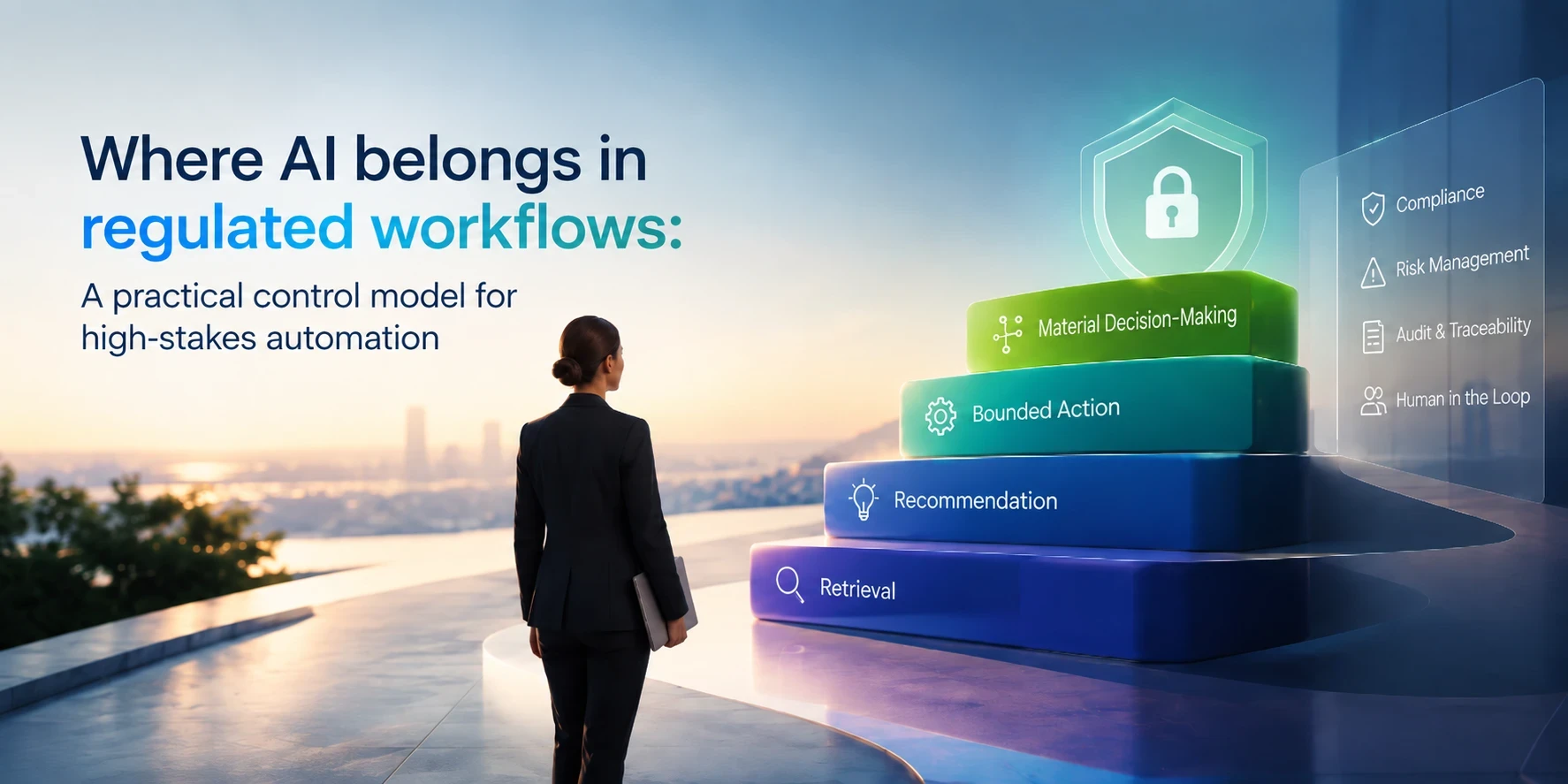
AI is entering regulated operations through a side door.
A compliance analyst uses a model to summarize a filing. A licensing team asks it to compare supporting documents. A revenue-cycle team uses it to classify correspondence. A supervisor searches across policies in natural language. A workflow drafts an email, recommends an outcome or prepares the next task.
None of these examples requires an organization to declare that it has “automated the decision.”
Yet each one changes how information is interpreted, how work moves and where accountability sits.
That is why the useful question is no longer:
Should we use AI in this workflow?
The better question is:
What authority should the AI be allowed to exercise at this specific step?
That distinction matters. It separates useful automation from uncontrolled delegation.
For regulated organizations, the goal should not be to place a human approval button at the end of an otherwise opaque AI process and call it governance. The goal is to engineer the workflow so that the AI has a clearly defined role, its inputs and outputs are controlled, material actions are traceable, and human judgment remains where the consequences justify it.
This guide provides a practical model for doing that.
AI governance becomes clearer when you govern authority, not technology
Organizations often approach AI governance at the model level.
They ask which model is approved, where it is hosted, whether prompts are retained, what data can be sent to it, whether the provider trains on customer information, and which security controls apply.
Those are necessary questions.
They are not sufficient.
The same approved model can create very different risk depending on what it is allowed to do.
An AI system that searches an approved policy library and returns relevant passages has a different authority level from one that determines whether an application should be rejected. A model that drafts an analyst note creates a different exposure from one that writes directly into the system of record. A classifier that prioritizes a work queue is different from one that closes cases automatically.
The unit of governance therefore needs to be more granular than “the AI system.”
It should include the AI action inside the business process.
That action has at least five dimensions:
- What information can the AI access?
- What transformation or judgment can it perform?
- What downstream action can its output trigger?
- Can that action be reversed?
- What evidence is retained so a reviewer can reconstruct what happened?
This workflow-level view complements formal AI risk-management frameworks. NIST’s AI Risk Management Framework organizes AI risk work around Govern, Map, Measure and Manage, while its Generative AI Profile emphasizes governance, pre-deployment testing, content provenance and incident disclosure. The practical implication is straightforward: trustworthy AI is not created by a policy document alone. Controls need to exist in the operating system around the model.
The AI authority ladder
A useful way to design controls is to define how much authority AI is exercising at each workflow step.
The following ladder moves from lower-authority assistance to higher-authority action.
| Level | AI role | Example | Typical control posture |
|---|---|---|---|
| 1 | Retrieve | Find relevant procedures, filings, policies or records | Approved sources, access controls, citations/provenance |
| 2 | Extract and classify | Pull fields from documents, classify submissions, detect document types | Confidence thresholds, validation rules, sampled QA |
| 3 | Summarize and compare | Summarize a case, compare a submission against requirements, identify inconsistencies | Source grounding, reviewer access to evidence, no silent overwrite |
| 4 | Recommend | Suggest priority, next action, risk flag or disposition | Human decision owner, explanation/evidence, override capture |
| 5 | Draft | Prepare correspondence, case notes, requests for information or workflow responses | Human review before external or authoritative use |
| 6 | Execute bounded actions | Create a task, route a case, update a non-material status, request missing information | Predefined action set, reversible actions, logging, exception handling |
| 7 | Make or trigger material decisions | Approve, reject, sanction, deny payment, alter a regulated status or create another high-impact consequence | Strong presumption for accountable human decision-making unless law, policy and risk analysis explicitly support automation |
The ladder is not a legal classification and should not be treated as one.
It is an engineering tool.
It helps business, risk and technology teams discuss the same thing: how much organizational authority is being delegated to the AI at this point in the process?
That question is much more concrete than debating whether a use case is “high risk” in the abstract.
Start with the workflow, not the model
A common mistake is to start AI projects with a list of model capabilities:
- summarization;
- question answering;
- classification;
- document extraction;
- reasoning;
- agentic action.
Then teams look for places to use them.
In regulated operations, the better sequence runs in the opposite direction.
Start with the workflow.
Where does work wait?
Where do people repeatedly search across documents?
Where is the same information re-keyed?
Where are analysts spending time preparing material rather than exercising judgment?
Where are cases returned because something obvious was missing?
Where does management lack visibility because the underlying workflow is fragmented?
Those are potential AI opportunities.
The purpose is not to maximize the amount of AI in the process. It is to remove low-value cognitive and administrative work while preserving control over the decisions that matter.
If your organization is still dealing with fragmented approvals, manual handoffs or disconnected systems, the broader Intelligent Automation capability may matter as much as the AI itself. AI should improve an operating model, not become another isolated tool sitting beside it.
A practical test for every AI-enabled step
Before adding AI to a regulated workflow, answer seven questions.
1. What is the business outcome?
Avoid use cases defined as “add AI to licensing” or “use GenAI for compliance.”
Define the operational result.
Examples:
- reduce the time analysts spend locating relevant information;
- identify incomplete submissions earlier;
- reduce manual document classification;
- prepare consistent case summaries before review;
- improve queue prioritization;
- draft routine requests for missing information;
- surface related entities or historical activity for investigation.
A clear outcome makes it possible to measure whether the AI improves the process rather than simply adding novelty.
2. What is the authoritative source?
If an AI system is answering questions, summarizing a case or comparing an application with requirements, the organization needs to know which information it is permitted to treat as authoritative.
That may include:
- approved policy and procedure documents;
- the current regulatory rule set;
- records in a case-management platform;
- structured application data;
- document-management content;
- verified data warehouse or operational-system records.
This is one reason data foundations matter: common definitions, source ownership and data readiness need to be established before architecture is allowed to drive the program.
The same principle applies to AI.
A model cannot compensate for unresolved disagreement about what the underlying information means.
3. What authority is the model exercising?
Place the use case on the AI authority ladder.
If the model retrieves information, the primary challenge may be source quality and access.
If it recommends an outcome, the challenge includes decision accountability and bias.
If it can trigger an action, the workflow needs stronger controls around action boundaries, reversibility and exception handling.
Do not use a single “human in the loop” label for all three.
They are different control problems.
4. What happens when the model is wrong?
This is one of the most useful design questions because it forces the team to consider consequence rather than model accuracy alone.
If a summary omits a minor point, a reviewer may catch it.
If a missing-document classifier incorrectly marks an application as complete, downstream work may proceed on an invalid assumption.
If an AI-generated recommendation influences a sanction, denial or regulatory decision, the consequence is materially higher.
The required control should reflect the impact of error, not merely the average performance of the model.
5. Can the action be reversed?
Reversibility is an underrated governance tool.
Creating a draft task is easier to correct than sending an external decision.
Adding a recommendation to a work queue is easier to reverse than changing an authoritative record.
For early AI deployments, organizations can often create significant value by allowing AI to perform actions that are bounded and reversible while preserving human authorization for material consequences.
6. What evidence must be retained?
A regulated workflow should make it possible to reconstruct important actions.
Depending on the use case, evidence may include:
- the input record or document version;
- the sources retrieved;
- the prompt or system instruction;
- the model/version identifier;
- the generated output;
- confidence or validation results where meaningful;
- the user who reviewed it;
- the human decision;
- overrides or corrections;
- timestamp and downstream action.
Not every AI interaction needs the same level of retention.
But material workflow steps should not become less auditable because AI was introduced.
7. Who owns the decision?
Every material outcome should have a clear accountable role.
“Human review” is not a role.
The workflow should identify whether the accountable decision-maker is a licensing officer, compliance analyst, supervisor, clinician, revenue-cycle specialist, manager or other designated authority.
NIST guidance explicitly emphasizes defining human roles and responsibilities for AI oversight. That becomes operational only when those roles exist inside the workflow rather than in a governance document no one sees during the work.
Human-in-the-loop is a design pattern, not a control by itself
“Human in the loop” is often used as if it resolves AI risk.
It does not.
A human reviewer can become a weak control if:
- the AI output is presented as the default answer;
- the reviewer cannot see the underlying evidence;
- workload makes genuine review impractical;
- the interface encourages rapid acceptance;
- overrides are difficult;
- the reviewer lacks authority or subject-matter expertise;
- no one measures whether reviewers actually identify errors.
A stronger design makes the human role specific.
For example:
AI extracts the relevant fields and identifies missing items. Deterministic validation rules check required fields. The licensing officer reviews exceptions and approves the completeness status before the application moves to substantive assessment.
That is much stronger than:
AI reviews the application and a human remains in the loop.
The first description identifies what the AI does, what rules do, what the human does and when the workflow can proceed.
The best early use cases usually compress information work
Financial authorities are already experimenting with generative AI in supervision, but the most mature uses remain relatively focused. A 2025 Financial Stability Institute stocktake grouped many reported applications into document processing, knowledge management and document review. It also highlighted familiar constraints: outdated IT, data security, user acceptance and inaccurate outputs.
That pattern is useful beyond financial supervision.
For most regulated organizations, early AI value is likely to come from compressing information work rather than handing over final decisions.
Good candidates include:
Document intake and preparation
AI can classify incoming documents, extract relevant information, detect obvious omissions and route material to the correct queue.
The workflow should retain the source document and make extracted values reviewable.
Policy and procedure retrieval
A governed retrieval system can help employees find the right policy, operating procedure or requirement faster.
The answer should link back to approved source material rather than present generated text as authority.
Case summarization
AI can prepare a structured summary of a long case history, filings, notes and correspondence.
The summary should be treated as a navigation aid, not a replacement for the underlying record.
Comparative review
AI can help compare a submission against known requirements or compare a new document with a previous version.
The system should make differences inspectable and allow reviewers to see the evidence behind the comparison.
Draft correspondence
AI can prepare routine communications, requests for information or internal notes.
External communications and authoritative records can remain subject to human approval.
Queue prioritization
AI can help prioritize work based on defined indicators.
That requires special attention to the factors used, the possibility of bias, and whether prioritization could create unequal treatment or systematic blind spots.
These are useful places to connect Applied AI with workflow engineering rather than treating them as separate initiatives.
Deterministic rules still matter
The arrival of generative AI does not make traditional business rules obsolete.
In many regulated workflows, the strongest architecture combines several types of logic:
- deterministic validation for requirements that are explicit;
- workflow rules for routing and authorization;
- integration logic for system-to-system actions;
- AI for unstructured interpretation, summarization, retrieval or recommendation;
- humans for accountable judgment and material exceptions.
Consider an application process.
If legislation or policy requires five documents, a deterministic rule can check whether all five have been provided.
AI may help classify the uploaded documents or identify whether one appears incomplete.
A human may decide whether an unusual substitute document satisfies the requirement.
Using AI for every layer would create unnecessary uncertainty.
Good automation chooses the simplest reliable mechanism for each task.
Put governance inside the architecture
A regulated AI workflow should be designed so that key controls are part of normal operation.
That includes:
Identity and access
The AI should operate with the minimum information and system permissions required for the use case.
Approved data boundaries
Sensitive information should not move into unapproved services simply because an employee can paste it into a prompt.
Source provenance
For retrieval and knowledge use cases, users should be able to distinguish source content from generated interpretation.
Version control
Material changes to models, prompts, retrieval sources or workflow rules should be managed as controlled changes.
Testing
Testing should cover more than “does the model usually give a good answer?”
Include representative difficult cases, missing data, conflicting documents, unusual formats, adversarial or misleading input where relevant, and downstream workflow behavior when the AI fails.
Monitoring
Monitor the operational result: corrections, override rates, exception rates, user behavior, false positives/negatives where measurable, incidents and drift.
Incident handling
The workflow should define what happens when the AI produces an unsafe or materially incorrect result.
These controls also overlap with security and risk management, because AI governance is an access, data-protection, third-party and resilience problem as well.
A simple deployment model: assist, control, expand
Organizations do not need to begin with fully autonomous AI.
A more practical sequence is:
Phase 1: Assist
Use AI for retrieval, extraction, summarization and drafting.
Keep authoritative actions outside the model.
Measure time saved, quality, correction patterns and adoption.
Phase 2: Control
Connect AI into the workflow with explicit review points, approved data boundaries, logging, validation and role-based actions.
Allow bounded actions where the consequence is low and reversibility is high.
Phase 3: Expand
Extend to more complex recommendations or actions only where evidence shows that the earlier controls work and the business case justifies greater delegation.
This phased approach creates something more valuable than an AI demo.
It creates operational evidence.
When agentic AI enters the workflow
Agentic systems increase the importance of authority design because they can chain together multiple actions: retrieve information, reason over it, call tools, update systems and initiate follow-up work.
That can be extremely useful.
It also means the risk is no longer limited to the generated text.
The agent’s permissions become part of the control environment.
For each tool an agent can call, ask:
- what systems can it access?
- what records can it read?
- what records can it change?
- can it communicate externally?
- can it create commitments?
- can it trigger another workflow?
- what approval is required before tool execution?
- can actions be rolled back?
- are all actions logged?
An agent should not inherit broad authority simply because the human user has broad authority.
Permission design is part of AI workflow design.
What executives should ask before approving an AI workflow
A useful executive review does not need to become a model-engineering meeting.
It should be able to answer these questions clearly:
| Question | What a strong answer sounds like |
|---|---|
| What problem are we solving? | A measurable workflow problem, not “we want to use AI” |
| What does AI do? | A specific action inside the process |
| What does AI not do? | Explicit authority boundaries |
| Which sources can it use? | Named, approved systems or repositories |
| Who owns the outcome? | A real accountable role |
| What happens when it is wrong? | Defined exception and recovery path |
| What evidence do we retain? | Sufficient traceability for the consequence |
| How will we know it works? | Operational, quality and risk metrics |
| What changes require reapproval? | Defined change-control triggers |
If the project cannot answer these questions, the workflow is probably not ready for production.
The objective is controlled intelligence
The strongest regulated AI systems will not be the ones that remove the most humans.
They will be the ones that allocate work intelligently.
Machines should do what machines are good at: search, compare, extract, summarize, classify, draft and process large volumes consistently.
Deterministic rules should enforce requirements that are truly deterministic.
People should retain accountable judgment where context, discretion and consequence require it.
And the workflow should connect those elements into one auditable operating system.
That is the practical meaning of governed AI.
Not less innovation.
More control over where intelligence is allowed to act.
If your organization is designing an AI-enabled operational process, Amayztech can help connect Applied AI, Intelligent Automation, integration and governance into a production workflow rather than a standalone proof of concept.
Frequently asked questions
What is human-in-the-loop AI?
Human-in-the-loop AI is a design approach in which a person reviews, validates or decides on an AI-generated output at a defined point in a process. In regulated workflows, the human role should be explicit: what the reviewer must assess, what evidence is available, whether the reviewer can override the system and what happens after approval.
Can AI make compliance or regulatory decisions automatically?
That depends on the decision, applicable law and regulation, organizational policy, risk tolerance and the controls around the system. For high-impact decisions, organizations should be cautious about delegating material authority to AI. A safer starting point is often to use AI for retrieval, extraction, comparison, summarization and recommendation while retaining an accountable human decision-maker.
What are the best first AI use cases for regulated organizations?
Strong early candidates usually involve information-heavy work: document classification, data extraction, policy search, case summarization, comparison against requirements, draft correspondence and work-queue prioritization. These can produce measurable productivity gains without requiring the AI to make the final material decision.
How should AI actions be audited?
The evidence required depends on the consequence of the action. For material workflow steps, organizations may need to retain the source information, model or system version, relevant instructions, generated output, reviewer identity, final human decision, overrides, timestamps and downstream actions.
Should AI governance be separate from workflow governance?
No. Enterprise-level AI policies are useful, but the controls become effective when they are embedded in the operating process: access control, approved data sources, review steps, validation, action permissions, monitoring, change control and incident handling.
Sources and further reading
- NIST AI Risk Management Framework
- NIST Artificial Intelligence Risk Management Framework: Generative Artificial Intelligence Profile
- NIST AI RMF Playbook
- Financial Stability Institute: Starting with the basics — a stocktake of generative AI applications in supervision
- Financial Stability Institute: In data we trust? Emerging policy and supervisory approaches to AI data use in financial services
- OECD: Supervision of artificial intelligence in finance
External references are cited for context. No endorsement of Amayztech by NIST, the Financial Stability Institute, the BIS or the OECD is implied.
Next step
Designing AI into a regulated workflow?
Amayztech helps organizations move from isolated AI experiments to governed operational systems by combining AI, workflow automation, integration, data engineering and risk-aware delivery.
Related capabilities
Working through a similar question?
Bring us the operating problem.
We help organizations work through the process, data and technology choices behind complex modernization programmes.
Get in touch