

Financial Services
Move financial operations faster — without weakening control.
Amayztech modernizes onboarding, lending, servicing, compliance and reporting workflows around the systems you already use — reducing manual handoffs, making exceptions visible and giving teams a clearer operating view from intake to resolution.
Better operations create faster decisions, clearer control and a better client experience.
- Onboarding & KYC
- Lending workflows
- Document automation
- Compliance operations
- Reporting & BI
- Client portals
Inside the operation
The delay usually sits between the systems.
Core platforms, origination systems, CRMs and document repositories may each do their own job well. The friction appears in the handoffs between them — where people re-key information, chase missing documents, reconcile status and decide what needs attention next.
Incomplete work enters the queue
Applications and requests reach staff before required documents or information are complete.
People bridge system gaps
Staff copy data, download files, update trackers and move work between applications because the operating flow is not connected.
Exceptions are found too late
Missing evidence, KYC issues, policy exceptions and stalled requests become visible only after somebody manually checks the file.
Status becomes a service problem
Clients call because internal state is fragmented across teams, inboxes and systems.
Reporting starts outside the process
Management information is assembled afterwards instead of being generated from the live operation.
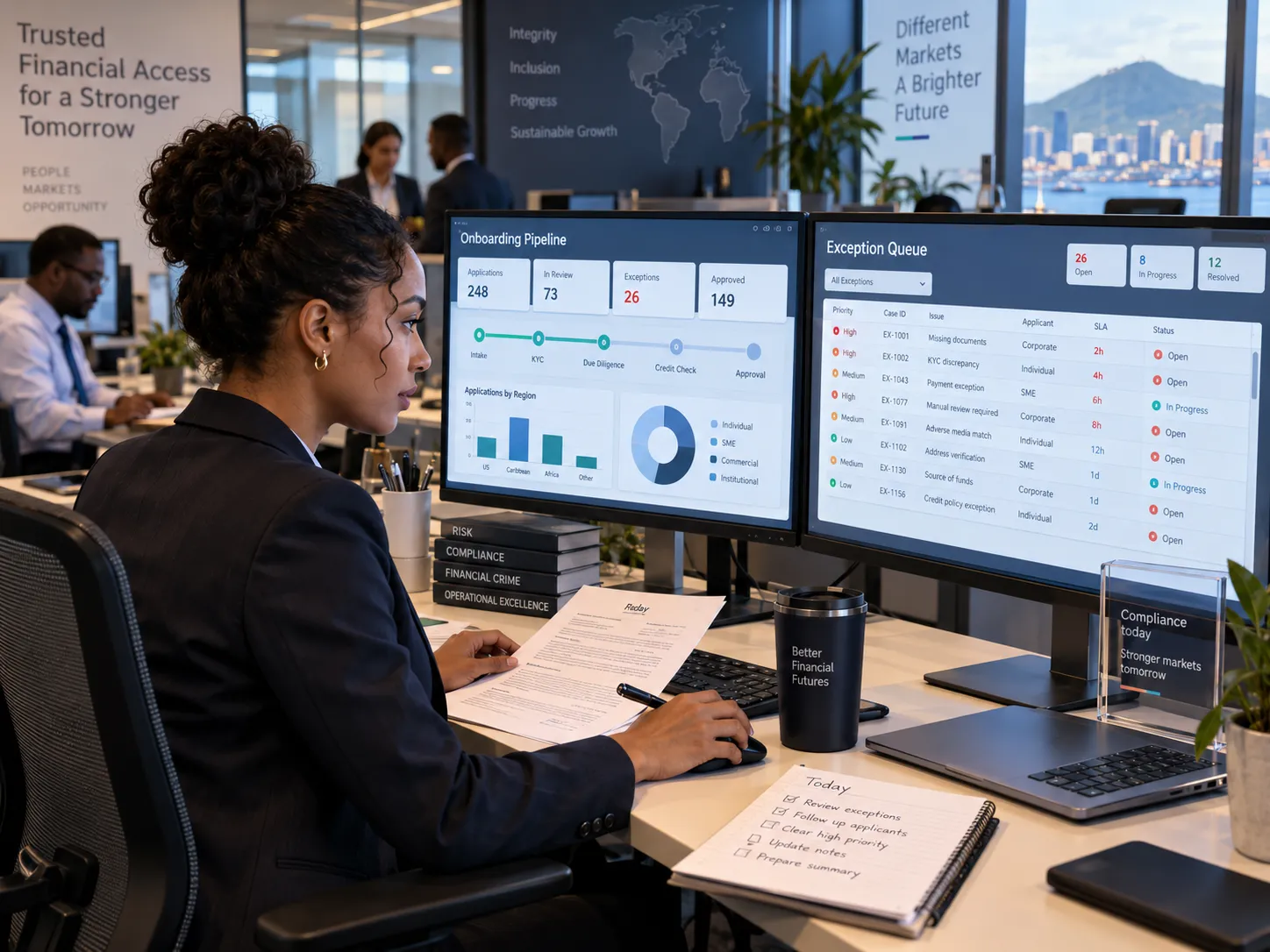
The goal is not more automation everywhere. It is less manual movement around the decisions your people already need to make.
Financial operations
Modernize the work around the core.
We work across the operational layers that connect an external submission to an internal review, decision, ongoing obligation and service record.
Client Onboarding & KYC
Structure intake, requirements, identity/KYC checks, document collection and review so a client or account does not depend on email and manual follow-up.
Lending & Credit Operations
Coordinate application intake, document readiness, verification, routing, credit preparation, approvals and exception paths across consumer, SME and commercial processes.
Compliance & Financial Crime Workflow
Turn recurring checks, escalations, reviews and evidence into attributable process steps rather than disconnected checklists.
Servicing & Client Requests
Route modifications, disputes, information requests, account changes and service cases with visible ownership and status.
Documents & Intelligent Processing
Classify documents, extract information, validate expected evidence and send uncertain items to a person for review.
Operational Reporting & Decision Intelligence
Give teams and leadership a trusted view of workload, ageing, exceptions, bottlenecks, service levels and operational performance.
How Amayztech helps
Four capabilities that reinforce the same operation.
Workflow Automation
Coordinate intake, approvals, system actions, reminders and human decision points across the operation.
Data, BI & Decision Intelligence
Build trusted operational reporting across workload, ageing, service levels and exceptions.
Applied AI
Use AI for classification, extraction, comparison and bounded assistance while keeping consequential decisions with people.
Digital Foundation & Portals
Connect applications, uploads, messages and status to the processes and systems behind them.
Client experience
Faster operations matter when the client can feel the difference.
Better workflows should reduce uncertainty for the client as well as effort for staff. Structured requirements, secure document exchange, clearer status and fewer repeated requests create a service experience that feels deliberate rather than improvised.
Clearer requirements
Clients know what is needed before the file reaches review.
Fewer avoidable follow-ups
Missing items and requests stay attached to the process rather than disappearing into email.
Better status
The client sees what is happening without requiring staff to manually reconstruct it.

Control & resilience
Speed matters. So do evidence, access and control.
Auditability
Workflow state, actions, approvals and supporting evidence should be attributable and reconstructible.
Human authority
Automation can prepare, route and validate work. Credit, compliance and other consequential decisions stay with accountable people where required.
Integration-first architecture
Existing systems remain authoritative where they still make sense. We connect them before proposing replacement.
Security & access
Role-based access, system boundaries and data handling are designed around the sensitivity of the operation.
Exception management
The operating model should make uncertainty visible rather than allowing it to disappear inside a queue.
Operational resilience
Handover, documentation and support are part of the design so key workflows do not depend on one person knowing how they work.
How we work
Start with the operation costing the most time.
Map one real process end to end, redesign the flow, put a working version in front of users early, then extend it.
Follow the work
Map one real process end to end: what starts it, which systems are involved, where it waits, what gets re-keyed and where exceptions appear.
Redesign the flow
Remove unnecessary steps and define what workflow, APIs, RPA, AI-assisted processing and people should each do.
Build the first working process
Put a high-value flow into users’ hands early, validate it against real work and measure where the process improved.
Extend and hand over
Add adjacent processes, reporting and integrations, document the solution and train the team to operate and evolve it.
Selected experience
Experience with real financial-services workflow.
Amayztech has delivered workflow modernization for a financial-services group where SME lending depended on manual document collection and coordination before a file could reach credit review.
The engagement focused on structured intake, document readiness and workflow visibility — the same operating problems that appear across onboarding, lending and service operations.
Amayztech also delivers regulatory workflow and portal solutions, giving our team practical experience with the evidence, traceability and controls expected around regulated operations.
Why Amayztech
Why financial-services teams work with Amayztech
We work around the systems you already have.
A workflow problem should not automatically become a core-conversion programme.
We redesign before automating.
If a step exists only because the systems do not talk to each other, the future process should not preserve it blindly.
We understand regulated evidence.
Decisions, exceptions, documents and approvals need to remain attributable and reviewable.
We connect operations to visibility.
Workflow and reporting are designed together so status and performance come from the live operation.
Questions financial-services teams ask
Do we have to replace our core or origination system?
No. Most engagements start with existing systems. We identify what should remain authoritative and connect workflow, documents, integrations and reporting around it.
Can you integrate with our existing financial systems?
Yes, subject to the interfaces those systems expose. We work with APIs, file/data exchange, RPA and other integration patterns depending on the environment.
Where does RPA fit?
RPA is useful where repetitive screen-based actions still have to happen and APIs are unavailable or impractical. It works best as one execution method inside a broader controlled workflow.
Where does AI fit in financial operations?
AI is useful for bounded tasks such as document classification, extraction, summarization and discrepancy detection. Consequential decisions should remain with accountable people and uncertain output should have an explicit review path.
Can you improve onboarding and KYC without replacing the client portal?
Yes. The existing portal can often remain while the requirements, workflow, document handling, checks and system updates behind it are redesigned and connected.
How do you handle auditability?
Process state, user actions, approvals, evidence and exceptions can be recorded as part of the workflow so the history does not have to be reconstructed later from email and spreadsheets.
Can reporting be part of the same modernization?
Yes. Operational data from the workflow can feed dashboards and management reporting so workload, ageing, exceptions and service levels are visible from the same operating record.
What should we automate first?
Start with the operation where manual handling, delays, exception volume or client friction are concentrated and where the trigger and desired outcome are clear.
Show us where the client journey slows down.
Tell us how one operation runs today — onboarding, lending, compliance, servicing or document collection — and where people are still moving information manually. We’ll help identify the shortest path to a faster, more controlled operation.