
Cyber Resilience for Financial Regulators: Six Priorities That Matter
A practical cybersecurity checklist for securities commissions: critical services, access, third-party risk, incident response, recovery testing and cyber supervision.

A securities commission can have firewalls, backups and an IT support provider yet still struggle to answer a vital question: if a cyber incident disrupted regulatory operations tomorrow, what would keep running, what could be restored, and who would make the decisions?
Cyber resilience is not a count of security tools. It is the ability to protect, test and recover critical regulatory services. These six priorities give leadership a practical starting point.
Why regulators need to look beyond cybersecurity policies
IOSCO’s work on cybersecurity in securities markets recognizes cyber risk as a market-integrity and supervisory concern. NIST Cybersecurity Framework 2.0 provides a practical structure for managing risk through governance, identification, protection, detection, response and recovery. In 2026, CPMI-IOSCO also consulted on additional cyber-resilience tools for financial market infrastructures.
These sources emphasize demonstrable resilience, but establish no universal cybersecurity mandate for all securities commissions. Local duties and risks determine what applies.
Six cyber resilience priorities every commission should examine
1. Identify the services that cannot afford to fail
Start with operations, not servers. Which licensing, e-filing, supervision and enforcement services depend on databases, identity systems, documents, cloud platforms or vendors?
Evidence leadership should request: A critical-service map showing business owners, system dependencies, interruption impact and agreed recovery priorities. If the filing portal is unavailable, there should be an approved alternative for urgent submissions.
2. Control who can access regulatory information
Review privileged access, multi-factor authentication, supplier accounts, dormant users and separation between public portal users and regulatory officers.
Evidence to request: An access review showing who holds privileged rights, who approved them and when those permissions were last validated. Start by correcting the highest-risk exposures, not by replacing functioning systems.
3. Know which third parties could stop an essential service
Outsourced hosting, identity, email, monitoring or portal support can interrupt regulatory services if a provider fails or is compromised.
Evidence to request: A register of critical suppliers, services they support, escalation contacts, contractual recovery commitments and workable continuity or exit arrangements. Include dependencies that are easy to overlook, such as DNS and authentication.
4. Rehearse the first hours of a cyber incident
In an incident, who detects the threat, isolates systems, preserves evidence, briefs leadership and informs regulated entities?
Evidence to request: A recent tabletop exercise with named decision-makers, identified gaps and tracked corrective actions. Include business, legal, communications and IT staff, not security personnel alone.
5. Prove that recovery works
A successful backup job is not the same as a successful service recovery. Can the commission restore the application, data, permissions and integrations needed to resume work? Can it establish that restored regulatory records are complete and trustworthy?
Evidence to request: Results from an actual recovery test, including time taken, data-integrity checks, unresolved failures and approved recovery objectives. Test one important service end to end before assuming the whole environment is resilient.
6. Make cyber supervision useful, where the mandate requires it
Protecting the commission differs from supervising regulated firms. Where legally authorized, secure incident reports should connect affected entities, disruptions and remediation.
Evidence to request: A documented cyber incident reporting and review process, with clear reporting triggers, confidentiality controls, case ownership and follow-up. The Financial Stability Board’s FIRE format offers a useful reference for interoperable cyber and operational incident reporting, not a universal compulsory reporting template.
Where should your commission begin?
If you are establishing a cybersecurity program: First map critical services, assess the most consequential access and technology risks, assign control owners, and agree a prioritized remediation plan. A manageable baseline is more valuable than a large policy document that no team can execute.
If you already have a mature security program: Validate whether the controls work. Test recovery, challenge third-party dependencies, review unresolved high-impact findings and examine whether leadership receives decision-ready resilience reporting. Build on your existing tools and security partners rather than replacing them automatically.
If cyber supervision is a priority: Start with the information officers actually need from regulated entities, the legal basis for requesting it, and how incidents, supporting evidence and remediation will be managed securely. This can be a separate workstream from the commission’s internal security program.
The six-question leadership check
At your next risk committee meeting, ask:
- Which three regulatory services would create the greatest disruption if unavailable?
- Have privileged accounts and supplier access been independently reviewed?
- Do we know which vendors are essential to those services?
- Have leadership and operational teams rehearsed a serious cyber incident?
- When did we last restore and verify a critical service, not just its backup?
- If our mandate includes cyber supervision, can we receive and follow up on significant firm incidents securely?
An answer based on assumption rather than evidence identifies a useful assessment priority.
How Amayztech helps commissions take the next step
Amayztech combines cybersecurity assessment and implementation capabilities with practical experience in regulatory portals, workflows, integration and long-lived operational systems. We focus on strengthening what already works and addressing the gaps that could interrupt regulatory services.
Our Commission Cyber Resilience Readiness Review is a scoped starting engagement. Depending on the agreed systems and access, it can produce a critical-service and dependency view, prioritized control and recovery findings, an executive action scorecard and a practical 90-day improvement roadmap. Follow-on work can address access remediation, system hardening, response exercises, recovery testing or ongoing technical support.
For commissions with a cyber supervisory mandate, we can separately scope secure incident intake, review workflows, regulated-entity risk information and supervisory reporting.
Start with one critical regulatory service or one cyber supervisory process. Explore Amayztech’s Cybersecurity & Operational Resilience solutions and discuss a focused review.
Selected references
Related Resources

Governing AI in investor protection: a practical framework for financial regulators
Investors are already asking AI tools about investments. This framework shows how securities and financial regulators can govern investor-facing AI: approved sources, cited answers, deterministic register checks, privacy and human accountability.

Modernizing regulatory technology without replacing everything at once
A practical approach to regulatory technology modernization: connect useful systems, modernize high-friction journeys, and replace legacy platforms only where the operating model requires it.
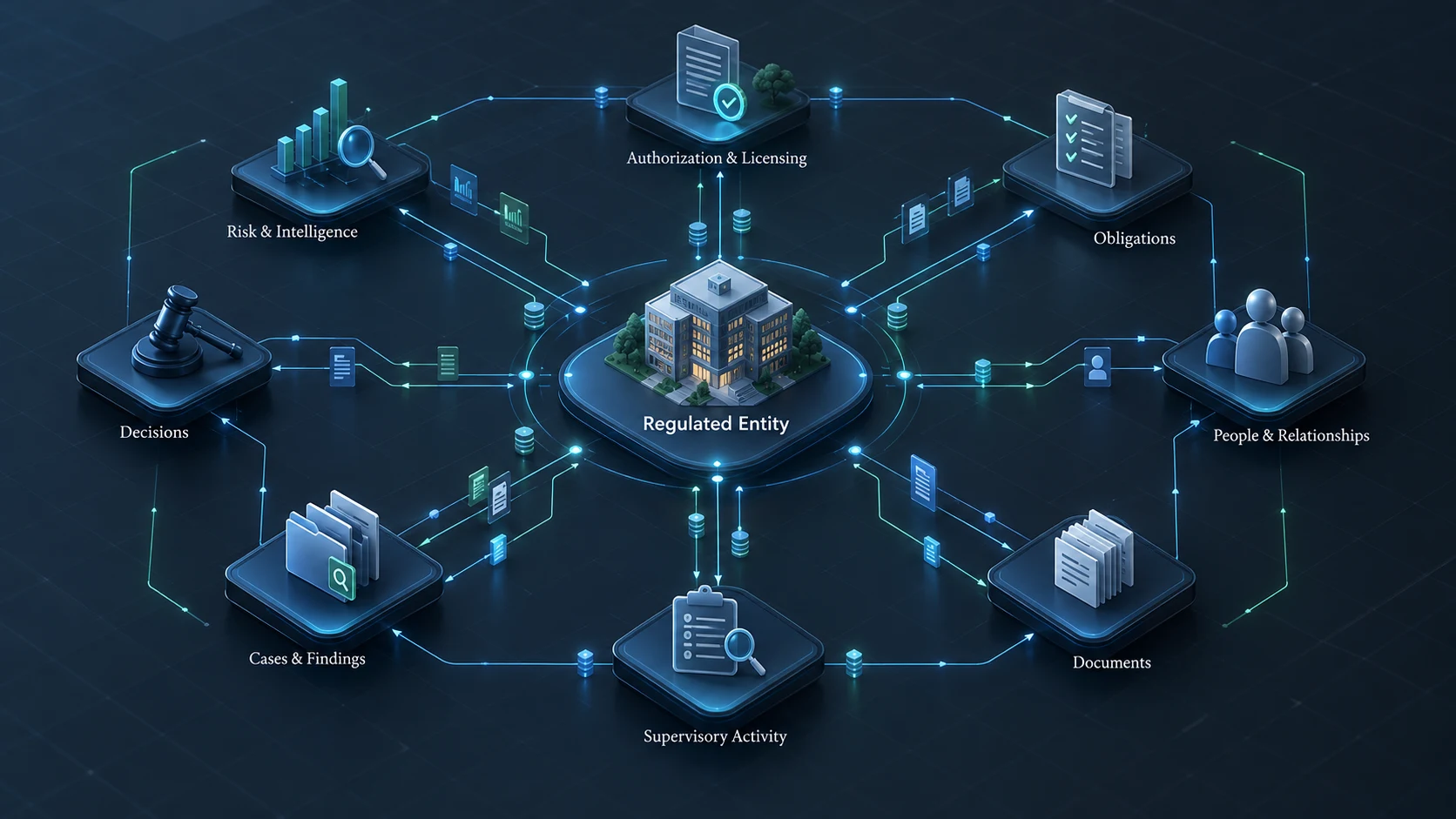
The modern supervisory system of record: what should actually be connected?
Regulatory information becomes significantly more useful when licences, filings, obligations, supervisory work, cases and decision history remain connected around the regulated entity.
Working through a similar question?
Bring us the operating problem.
We help organizations work through the process, data and technology choices behind complex modernization programmes.
Get in touch