
Governing AI in investor protection: a practical framework for financial regulators
Investors are already asking AI tools about investments. This framework shows how securities and financial regulators can govern investor-facing AI: approved sources, cited answers, deterministic register checks, privacy and human accountability.

Investors are already asking AI tools about investments. They ask whether a firm is licensed, whether a “guaranteed” return is realistic, and what to do when a broker stops answering. The answers they get today come from general-purpose systems that have never read your warnings, your register or your guidance, and that cannot tell an investor which source to trust.
Financial regulators hold exactly the information those investors need. The question is no longer whether AI will sit between investors and that information. It is whether regulators will govern how it does.
This article sets out a practical framework for doing that well: what makes investor-facing AI different, the principles that keep it trustworthy, an operating model your teams can run, and the questions to ask before you buy.
Why investor-facing AI needs its own rules
Most AI governance guidance was written for firms using AI inside their own operations. An investor-facing assistant run by, or on behalf of, a regulator raises three additional concerns.
Authority transfers to the answer. When an answer appears on a regulator’s domain, investors read it as the regulator speaking. A confident but wrong answer about a firm’s status carries the weight of the institution, not of a chatbot.
The cost of error is uneven. Telling an investor that a cloned website is genuine can cost them their savings. Telling them to check the official register costs them a minute. A well-governed assistant is built to prefer the second outcome whenever it is unsure.
Fraud already uses AI. Fabricated endorsements, cloned websites and synthetic voices are now ordinary features of investment scams. A regulator’s assistant has to help investors recognise these patterns without ever declaring, on its own authority, that a specific person or firm is committing fraud.
Seven principles for trustworthy answers
1. Answer only from approved sources
The assistant should draw its answers from content the regulator has explicitly approved: published guidance, investor warnings, enforcement notices, the public register and approved transcripts of the regulator’s own videos and podcasts. Open-web content, user uploads and unreviewed material stay out.
Two approvals should be kept separate. Approving a page for publication is not the same as approving it for use in AI answers. A podcast can be worth recommending without its transcript being approved as evidence. Keeping the two decisions apart gives editors precise control over what the assistant may cite.
2. Cite, date and link every answer
Every substantive statement should point to its source, with the publication or “last checked” date visible. Citations let investors verify the answer, let staff audit it, and make stale content obvious. An answer that cannot be traced to an approved source should not be given.
3. Keep regulatory facts deterministic
Some answers must never be generated by a language model. Whether a firm is authorised, what activities it may carry on, and when its licence expires are facts held in the register. They should be read from structured register data by deterministic logic and presented with their source and date. The language model’s role is to explain what the result means, not to decide it.
4. Know when not to answer
A trustworthy assistant says plainly when the approved sources do not cover a question and points the investor to the right official channel: the register, a published warning, or the regulator’s complaints process. It does not give personal investment advice, predict prices or comment on whether a named individual is acting unlawfully.
5. Be transparent that it is AI
Investors should always know they are talking to an AI system, what it draws on and what it cannot do. This reflects a wider regulatory direction: the EU AI Act (Regulation (EU) 2024/1689), for example, includes transparency obligations so that people are informed when they interact with an AI system. Clear labelling also sets the right expectations: guidance from official sources, not a decision about the investor’s money.
6. Protect investor privacy by design
Questions often contain personal details: amounts lost, names of contacts, account numbers. Good practice is to collect as little as possible. Questions should not appear in page addresses, analytics tools or marketing attribution. Complaints and other confidential material belong in a separate, access-controlled workspace and should never be exposed to the public assistant.
7. Keep humans accountable
Named people, not the system, own each decision: which sources are approved, which answers are reviewed, when the assistant is paused. Staff need a simple way to see what investors are asking, where answers fall short, and which content needs updating. A kill switch that returns the service to a safe, non-AI fallback should be tested before launch, not after an incident.
An operating model your teams can run
Principles only matter if someone runs them every week. A light operating model for an investor-facing assistant has four roles and a short lifecycle.
| Role | Responsibility |
|---|---|
| Content owner | Publishes guidance, warnings and media; proposes content for AI use |
| AI approver | Approves or withdraws content as AI evidence; reviews flagged answers |
| Legal and compliance | Sets boundaries (no advice, no allegations), signs off disclaimers and escalation routes |
| Technology and security | Runs the platform, access control, logging, cost limits and incident response |
The content lifecycle
- Connect. Link the channels you already publish to: website, notices, register, video and podcast feeds.
- Review. New and changed items arrive in a review queue. Nothing reaches the assistant automatically.
- Approve. Approve for publication, for AI evidence, or both, with a reason recorded.
- Monitor. Watch unanswered questions, low-confidence answers and source changes.
- Retire. Withdraw superseded guidance so it can no longer be cited.
Evaluation before and after launch
Build a set of real investor questions, including the awkward ones: guaranteed returns, look-alike domains, expired licences and requests for personal advice. Run the assistant against them before launch and after every significant change, and record the results. Add adversarial tests that try to make the assistant invent a licence status, ignore its sources or reveal confidential data.
Mapping the framework to recognised standards
Regulators rarely need a new governance framework; they need to show how an AI service fits the ones they already recognise.
| Framework | How the practices above map to it |
|---|---|
| NIST AI Risk Management Framework (AI RMF 1.0) | Govern: named roles and approvals. Map: defined use and boundaries. Measure: evaluation sets and monitoring. Manage: kill switch, incident response, content retirement |
| NIST Generative AI Profile (NIST AI 600-1) | Grounding in approved sources, citation, and controls against confabulated answers |
| ISO/IEC 42001 | An AI management system: policy, roles, risk assessment, lifecycle controls and continual improvement |
| OECD AI Principles | Transparency, accountability, robustness and human-centred values |
| EU AI Act (Regulation (EU) 2024/1689) | Transparency towards people interacting with AI; documentation and human oversight as good practice |
Supervisory bodies are also examining AI in financial markets, including the Financial Stability Board’s 2024 report on the financial stability implications of AI and IOSCO’s 2025 work on AI in capital markets. These focus mainly on how firms use AI, but their emphasis on governance, data quality and accountability applies equally to a regulator’s own services.
A procurement checklist
Before selecting a vendor or approving an internal build, ask for clear answers to these questions.
- Can the assistant answer only from sources we approve, and can we withdraw a source immediately?
- Are publication approval and AI-evidence approval separate decisions?
- Does every answer show citations with dates, and can staff see exactly which sources were used?
- Is licence and register status read deterministically from register data rather than generated by a model?
- What does the assistant do when sources do not cover a question?
- How are questions kept out of URLs, analytics and logs, and how long is anything retained?
- Are complaints and restricted data technically separated from the public assistant?
- Where is the service hosted, who owns the data, and can it run in our own cloud account?
- Which model providers are used, and can we switch or disable AI without losing the service?
- What cost controls, rate limits and abuse protections are in place?
- How is the service evaluated, and will we receive the evaluation results?
- Does the solution work alongside our existing website and publishing tools, or does it require replacing them?
Start small, and prove it
The most effective programmes begin with a narrow scope: one investor journey, a few dozen approved sources and a defined evaluation set. A short pilot on a branded subdomain, linked from the existing website, lets the regulator measure answer quality, staff effort and investor demand before any wider commitment. Your website stays as it is; the assistant adds a trusted way to reach what you have already published.
Frequently asked questions
Can a regulator use generative AI without risking incorrect regulatory statements? Yes, if the assistant answers only from approved sources, cites them, reads register facts deterministically, and declines when sources do not cover a question. Human approval of sources and monitoring of answers remain essential.
Should an AI assistant tell investors whether a firm is a scam? No. It should report what official sources show, such as register status or a published warning, explain what that does and does not prove, and direct the investor to report concerns through official channels.
Do investor questions need to be stored? Only as far as necessary to operate and improve the service, under a defined retention policy. Questions should never appear in page addresses or third-party analytics.
Where should the assistant live? Typically on a regulator-branded subdomain linked from the existing website, so the regulator keeps its current publishing tools and retains control of branding, data and hosting.
Amayztech builds AmayzTrust, an AI investor assistant for financial regulators that answers investor questions from a regulator’s own approved guidance, with citations and human oversight. Try the interactive demo or book a tailored demo to see it working with content like yours.
Related capabilities
Related Resources

Modernizing regulatory technology without replacing everything at once
A practical approach to regulatory technology modernization: connect useful systems, modernize high-friction journeys, and replace legacy platforms only where the operating model requires it.
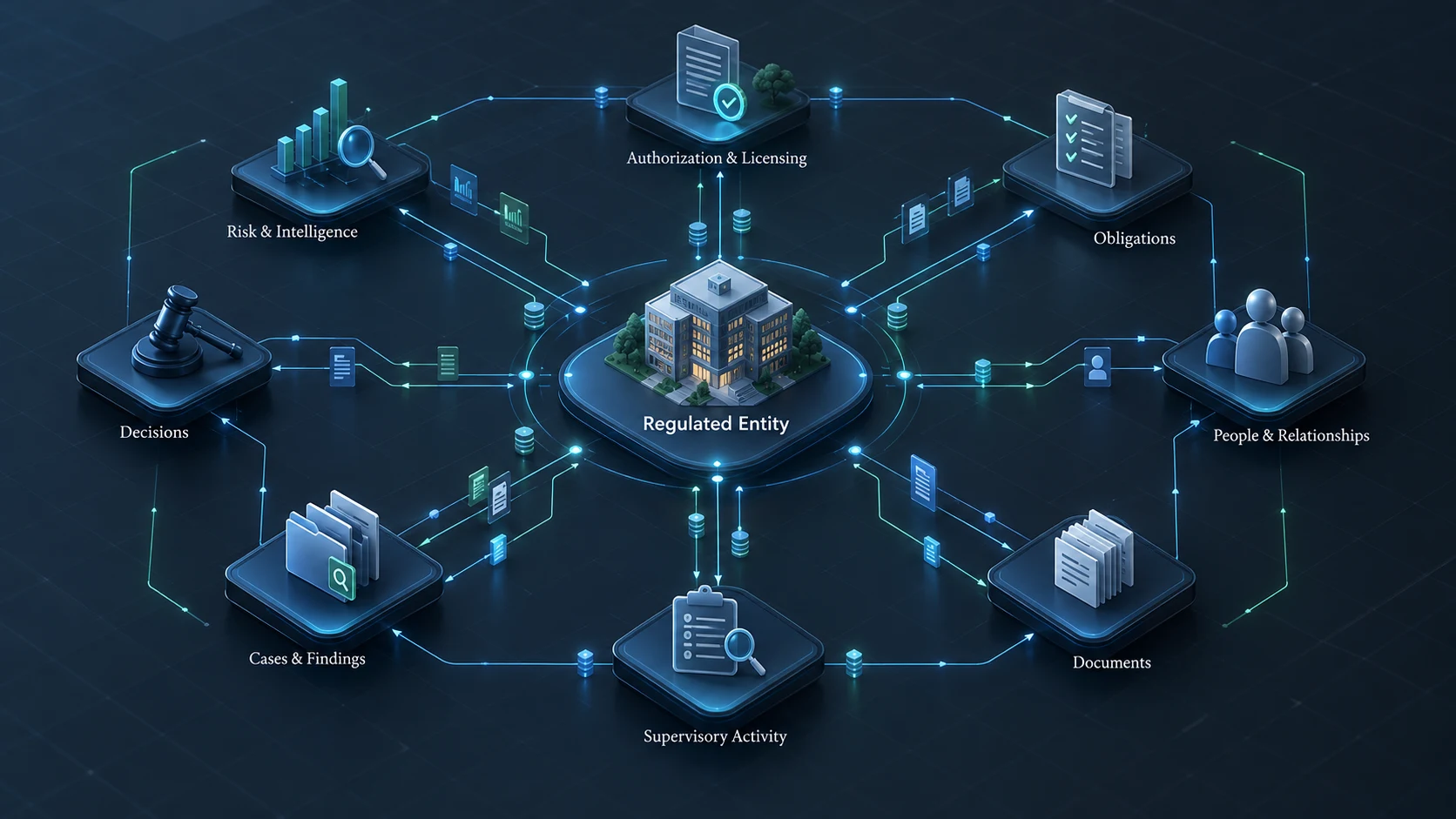
The modern supervisory system of record: what should actually be connected?
Regulatory information becomes significantly more useful when licences, filings, obligations, supervisory work, cases and decision history remain connected around the regulated entity.

Amayztech Delivers Enhanced CoRI Filings Portal for the Securities Commission of The Bahamas
Amayztech successfully delivers the enhanced CoRI filings portal for the Securities Commission of The Bahamas, bringing electronic applications, regulatory workflows and improved submission visibility into a connected service under Project Butterfly.
Working through a similar question?
Bring us the operating problem.
We help organizations work through the process, data and technology choices behind complex modernization programmes.
Get in touch